Which Supply Chain Roles Will
AI Replace First?
AI and robotics in supply chain, explained through an Australian recruiter's timeline — which roles are at risk, on what horizon, and what to do about it.
AI and robotics in supply chain are no longer a future risk to plan for — they're already reshaping which roles exist in Australian warehouses, planning teams and procurement functions. Having placed supply chain leaders across ANZ for 15 years, I've watched this shift accelerate faster than almost anyone predicted. This guide sets out, role by role, what's changing, on what timeline, and what to do about it.
What's Already Happening in Australia
AI and robotics in supply chain isn't theoretical anymore. The largest players in Australian supply chain have already placed multi-billion dollar bets on automation, and the investments keep coming.
Coles — $4B
Over $4 billion committed to automated distribution centres with Witron and Ocado. The Witron-powered ADCs in Queensland and New South Wales are operational, with a further $880 million announced for a third in Truganina, Victoria — capable of processing 4.6 million cartons per week. The Ocado facilities run over 1,000 robots each on hive grids, picking and packing online grocery orders in what are essentially lights-out warehouses.
Woolworths — NSW
Automated distribution centres at Moorebank Logistics Park in western Sydney, with robotic cranes and shuttles moving thousands of crates per hour across both store replenishment and direct-to-customer fulfilment.
Amazon — 75%
Continued expansion of its Australian robotics-driven fulfilment network — 75% of Amazon customer orders globally are now handled in part by robotics. A second Australian robotics fulfilment centre recently opened in Melbourne, following Kemps Creek in Western Sydney.
These aren't pilot programs — they are the new operating model. And the economics in Australia actively accelerate adoption: higher wages, a persistently tight labour market and vast geographic distances all improve the return on automation.
The Risk Timeline — Role by Role
This is the heart of how AI and robotics in supply chain will actually play out, role by role. Not every supply chain role faces the same disruption, or on the same timeline. Based on the roles I'm briefed on, the roles disappearing from job boards, and conversations with hiring managers — here is how I'd categorise the risk.
Warehouse pick, pack & despatch operators
Automation is hitting hardest and fastest here. Autonomous mobile robots, goods-to-person systems and robotic picking cells are replacing the manual labour model — goods-to-person alone lifts pick rates by 200–300%. Coles, Woolworths and Amazon already operate at scale. Human roles shift to system oversight, exception handling and robotics maintenance.
Inventory and stock clerks
Tracking levels, reordering and maintaining records is increasingly handled by AI-driven systems and IoT sensors, with cycle counting automated through RFID and drone-based scanning. The role moves from counting to analysing — and that distinction matters.
Transactional procurement — PO processing, invoice matching
Gartner estimates nearly 28% of procurement time goes on transactional sourcing — bids, POs and routine supplier interactions — and KPMG simulations suggest AI could automate 50–80% of current procurement tasks. Strategic professionals managing complex negotiations and category strategy remain essential.
Data entry and basic reporting
Any role primarily focused on moving data from one system into another is at immediate risk. AI tools already build dashboards and generate exception reports faster than a human. The analyst who can interpret the output and recommend action keeps their seat.
Demand planners and forecasters
AI-driven demand sensing from Blue Yonder, o9 Solutions and Kinaxis is already outperforming traditional statistical methods, incorporating real-time signals — weather, social media, competitor pricing — that a human planner can't process at the same speed. Coles already runs AI models built on 100+ variables. You'll need fewer planners, and those who remain must know how to tune and override the models.
Logistics coordinators and freight booking roles
Route optimisation, carrier selection, load planning and freight booking are increasingly handled by TMS platforms with embedded AI. The coordinator who spends the day booking freight and chasing ETAs is at significant risk. Those who manage carrier relationships, negotiate contracts and design network strategy will grow in importance.
Production planning and scheduling clerks
Machine learning can predict production needs and schedule automatically against capacity, materials and demand signals. Planners who manage complex multi-site scheduling, disruption scenarios and cross-functional coordination remain essential.
Category and spend analysts (procurement)
AI can analyse spend data, benchmark pricing and flag contract anomalies faster than an analyst in Excel. Gartner predicts that by 2027, half of procurement contract management will be AI-enabled. Category managers who combine insight with negotiation skill and cross-functional influence stay in demand.
Across every medium-risk role the split is the same: the production of analysis is automating, the interpretation of it is not. Fewer people, higher skill requirements, more commercial exposure.
Supply chain directors and VP / C-suite roles
Strategic leadership, board communication, cross-functional influence and organisational change management are deeply human capabilities. Nobody is putting an AI agent in charge of a $40M logistics budget, an EA negotiation, or a board presentation on network strategy.
Strategic sourcing and supplier relationship managers
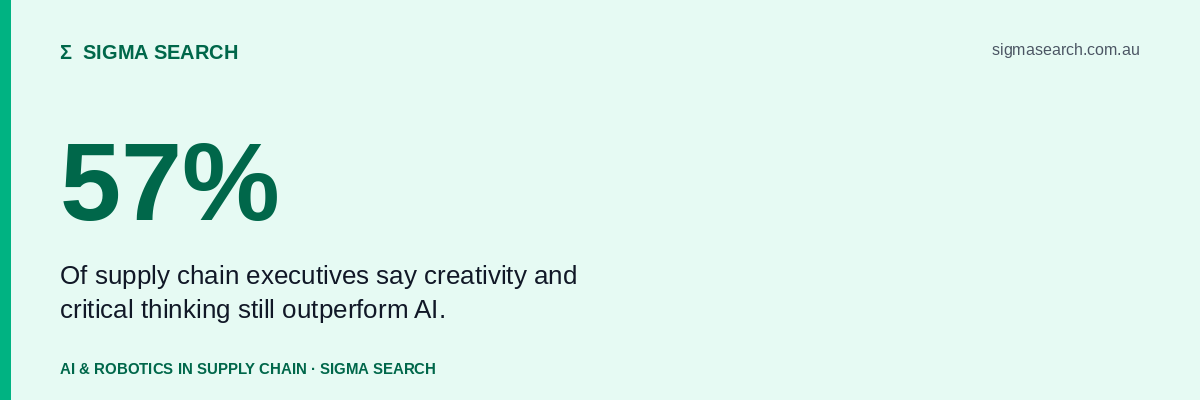
Complex negotiations with strategic suppliers require trust, cultural understanding and the ability to read a room. Deloitte found 57% of supply chain executives believe creativity and critical thinking significantly outperform AI — supplier relationship management is the embodiment of that.
Network design and strategy
Designing distribution networks, making facility location decisions and modelling end-to-end scenarios involves complex trade-offs and strategic judgement. AI tools can model the scenarios; interpretation remains human.
Warehouse and logistics site managers
Even in a highly automated facility, someone leads the people, maintains safety culture, navigates industrial relations and drives continuous improvement. The tools change; the leadership requirement doesn't.
Of supply chain executives believe creativity and critical thinking significantly outperform AI. The further your role sits from a repeatable transaction, the safer it is.
The Australian Context & What New Roles Will AI Create?
Australia's adoption curve has characteristics that supply chain professionals here should understand — and AI and robotics in supply chain are creating roles as fast as they're removing others.
Higher wages accelerate ROI
Australian warehouse workers earn significantly more than counterparts in Southeast Asia or the US, shortening the payback period on automation — so local companies have stronger incentives to automate sooner.
Geographic spread slows deployment
Full automation works brilliantly for a Coles NDC in Sydney processing millions of cartons a week. It works far less well for a regional distributor with 5,000 SKUs in Townsville. Mid-market will trail the majors.
The labour shortage is real
Persistent talent shortages since COVID are driving automation — companies aren't replacing people so much as filling gaps they can't hire for. Demand for robotics technicians and automation engineers is rising as a result.
Defence is creating new roles
The AUKUS pipeline and broader defence build-out is generating supply chain roles that didn't exist five years ago. Defence logistics, cleared professionals and aerospace procurement specialists are growing, not shrinking.
What new roles will AI create?
Gartner predicts that by 2030, 20% of procurement professionals will occupy AI-driven roles that don't exist today. A survey of 509 supply chain leaders found 86% believe agentic AI adoption will require entirely new processes for developing talent pipelines.
| AI & Automation Product Owners | Implementation and continuous improvement of AI tools inside supply chain operations |
| Robotics Fleet Managers | Overseeing autonomous warehouse robots and optimising human–robot collaboration |
| SC Data Governance Leads | Ensuring the data quality that every AI system ultimately depends on |
| Digital Supply Chain Analysts | Traditional supply chain knowledge combined with data science and AI literacy |
None of these existed five years ago. In another five they'll be standard on every mid-to-large supply chain org chart.
What Should You Do About It?
Whatever stage you're at, the response to AI and robotics in supply chain is the same principle applied differently: move up the value chain before the transactional part of your role is automated for you.
| If you're in a transactional role | Data entry, PO processing, basic reporting — start upskilling now. Learn Tableau or Power BI, get comfortable with AI tools, and understand how WMS and TMS platforms work at a system level. The window to transition is open, but it won't be forever. |
| If you're mid-level analytical or planning | Your job isn't going away, but it is changing fast. The value shifts from producing the analysis to interpreting and acting on it. Build stakeholder communication and commercial acumen — and on your resume and LinkedIn, lead with decisions influenced and outcomes delivered, not reports produced. |
| If you're in leadership | AI makes you more effective, not redundant — but you need to understand it. Leaders who can't discuss AI, automation and digital supply chain strategy will find themselves left behind. You don't need to code; you do need to know what's possible. |
| If you're hiring | Rethink your job descriptions. The best supply chain hires in 2026 combine operational experience with digital fluency and adaptability. Look for people who've implemented systems, driven change and embraced new technology. |
As automation reshapes distribution centres, the leaders who run them need a different mix of skills: systems fluency, change leadership and a sharp eye on cost-to-serve. If you’re building that kind of team, talk to our logistics recruitment specialists.
Key takeaways on AI and robotics in supply chain
01
High-risk roles are already being automated at scale by Coles, Woolworths and Amazon in Australia
02
Medium-risk roles transform over 3–7 years — fewer people, higher skill requirements
03
Low-risk roles stay human — leadership, negotiation and strategic judgement aren't automatable
04
Australian economics accelerate adoption, making ANZ one of the fastest-adopting markets globally
05
New roles are emerging — 20% of procurement roles by 2030 will be jobs that don't exist today
06
Upskill now — digital fluency and AI literacy are becoming baseline across every level
AI and robotics in supply chain aren't coming for every job in Australia — but they are reshaping which roles exist, what they look like and what skills they require. The professionals who thrive will move up the value chain — execution to analysis, analysis to strategy, strategy to leadership. The ones who resist won't have that luxury.
Wondering how automation affects your role?
We offer a free, no-obligation LinkedIn profile and resume review for supply chain, logistics and procurement professionals.
Book a free review →This guide to AI and robotics in supply chain has been prepared by Sigma Search for general information purposes. © Sigma Search 2026.