Resume Writing
Tips
Practical resume writing tips, fully updated for ATS-first hiring, AI-assisted screening and the competitive ANZ supply chain market.
If you work in Supply Chain, Logistics or Procurement, these resume writing tips are built specifically for how your resume actually gets read in 2026 — by an ATS first, and a hiring manager second. Having reviewed thousands of supply chain resumes over 15 years of executive search, I see the same fixable mistakes again and again. This guide walks through exactly what to change, in order of impact.
Structure & Presentation
These are the resume writing tips that shape the first impression, before a single line of your experience is even read.
Layout — make an instant impact
Layout is your number one priority. A hiring manager forms an impression within seconds, so the document must communicate your level instantly through clean structure, hierarchy and white space. Use Canva or a clean Word template — but avoid heavy graphics, multi-column layouts and text boxes if you're applying through ATS portals. They cause parsing errors that corrupt your application before a human ever reads it.
Workday, SuccessFactors, Lever and Greenhouse are now standard at most mid-to-large Australian employers. Submit .docx for online portals and save the designed PDF for email and direct networking — complex layouts become garbled in ATS parsers.
Executive summary — your seven-second window
Two to three punchy sentences covering qualification level, years of experience, sector, team size and budget responsibility. The reader should know your level before finishing the opening paragraph. In 2026, also signal digital literacy — ERP implementation experience, AI-driven forecasting tools or supply chain digitalisation credentials are increasingly expected at manager level and above.
Supply chain leader with 15 years across FMCG and Retail, directing end-to-end ANZ operations with direct teams of 40 and indirect accountability for 200+ 3PL staff, managing a combined logistics spend of $80M annually across SAP IBP and Kinaxis.
Play to your strengths
Lead with whatever makes you most competitive for the roles you want. MBA or Masters? Place education directly after your summary. Hands-on leadership your edge? Lead with experience. For supply chain professionals, a brief Core Competencies block early in the document — SAP, Oracle, JDA/Blue Yonder, Kinaxis, Power BI — is highly searchable and signals depth to both ATS systems and hiring managers.
Content & Quantification
This is where most resume writing tips articles stop — but content and quantification are what actually separate a shortlisted resume from one that gets filtered.
Career summary & chronology
A career timeline on your front page — employers, titles, dates — gives immediate context of trajectory. Show upward progression: planner to manager to director, always in reverse chronological order. Interim specialists should group by project type rather than listing every short engagement: Supply Chain Transformation or ERP Implementation reads far better than a list of 15 short contracts.
Quantify every achievement
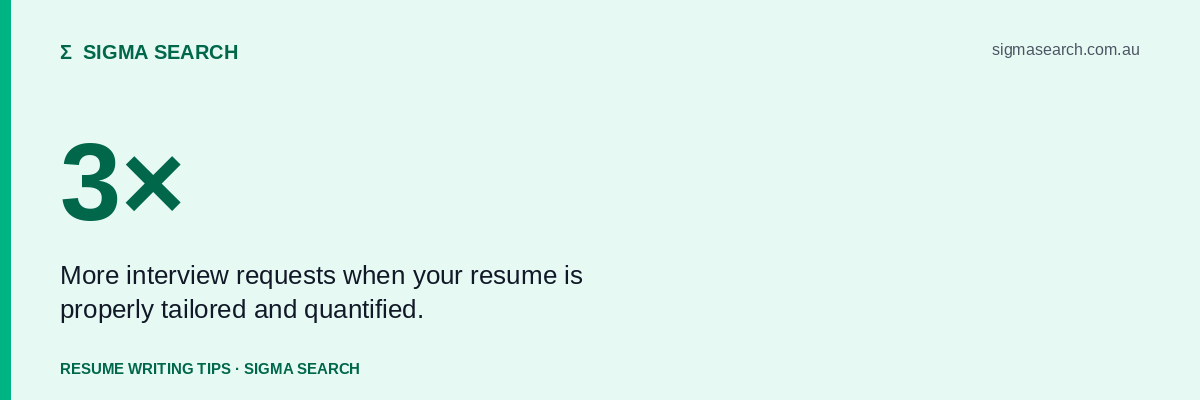
This is the single highest-impact change most supply chain professionals can make. Generic statements are invisible to both ATS and hiring managers; numbers make achievements concrete, credible and memorable. Every bullet should answer: how many, how much, what percentage, over what timeframe?
| Before | After |
|---|---|
| Managed supplier relationships | Managed 45 tier-1 suppliers across 8 categories, delivering $2.3M in savings over 18 months |
| Led the planning team | Led a 6-person S&OP team, improving forecast accuracy from 72% to 89% in 12 months |
| Reduced inventory | Reduced finished goods inventory by $4.1M (28%) while maintaining a 99.2% service level |
Resume length — quality over quantity
Four pages maximum, per the Career Development Association of Australia. Concentrate detail on the last five to seven years; for earlier roles give company, title and dates only, unless one is directly relevant by seniority or sector. If your resume hasn't been updated in six years or more, don't add to it — rebuild it from scratch around recency and relevance.
ATS, Tailoring & Digital Presence
The last set of resume writing tips are about making sure the right resume actually reaches a human, and that your digital presence backs it up.
ATS optimisation — the new essential
Before your resume reaches a human it is parsed, scored and ranked by software. Understanding how that works is now as important as the content itself. Five rules make the biggest difference to your score.
| Use standard headings | ATS looks for Work Experience, Education, Skills. Creative headings confuse parsing. |
| Mirror JD language exactly | If the ad says demand planning, use those words — not forecasting. ATS matches literally. |
| Avoid tables and text boxes | Content inside them is often invisible to parsers. Use plain text. |
| Spell out abbreviations | Write Sales and Operations Planning (S&OP) at least once before using the short form. |
| Submit .docx for portals | PDF is fine for email; for application portals .docx parses far more reliably. |
Tailor for every application
Fifteen minutes aligning your language to each job description dramatically improves ATS scoring and first-impression relevance. AI tools can compare your resume against a JD and flag gaps in coverage or terminology. That isn't fabrication — it's making sure genuine experience is described in the employer's own terms.
Never duplicate the job description verbatim — experienced recruiters spot it immediately. Use the JD as a reference to frame your achievements against the priorities that matter to that specific employer.
Writing style — active and concise
Use strong action verbs — Led, Delivered, Reduced, Implemented, Negotiated. No "I", no third person. Never take sole credit for team achievements; frame your contribution clearly: Led cross-functional team of 12 to deliver network redesign, achieving $3.2M in annualised freight savings.
Digital presence & LinkedIn URL
Include a clean custom LinkedIn URL (linkedin.com/in/yourname) in your contact details. Hiring managers and headhunters will visit immediately, and the profile must be consistent with your resume and equally well optimised — see the companion LinkedIn Optimisation Guide for the full checklist.
Key Resume Writing Tips to Remember
Six checks that separate a resume that gets read from one that gets filtered.
- 01First page impact. Layout, summary and career snapshot must land within seven seconds
- 02Quantify every achievement. Numbers, percentages and dollar values build credibility fast
- 03ATS-optimise. Plain format, mirrored JD language, standard headings only
- 04Tailor every application. Fifteen minutes of alignment significantly improves results
- 05Four pages maximum. Relevance over length — focus on the last five to seven years
- 06LinkedIn URL on your resume. Ensure profile consistency and keyword alignment with the document
Want a second opinion on your resume?
Sigma Search reviews resumes for supply chain, logistics and procurement professionals — candid feedback on structure, positioning and how you'll read to the market.
Book a resume review →This guide of resume writing tips has been prepared by Sigma Search for general career-advisory purposes. © Sigma Search 2026.